

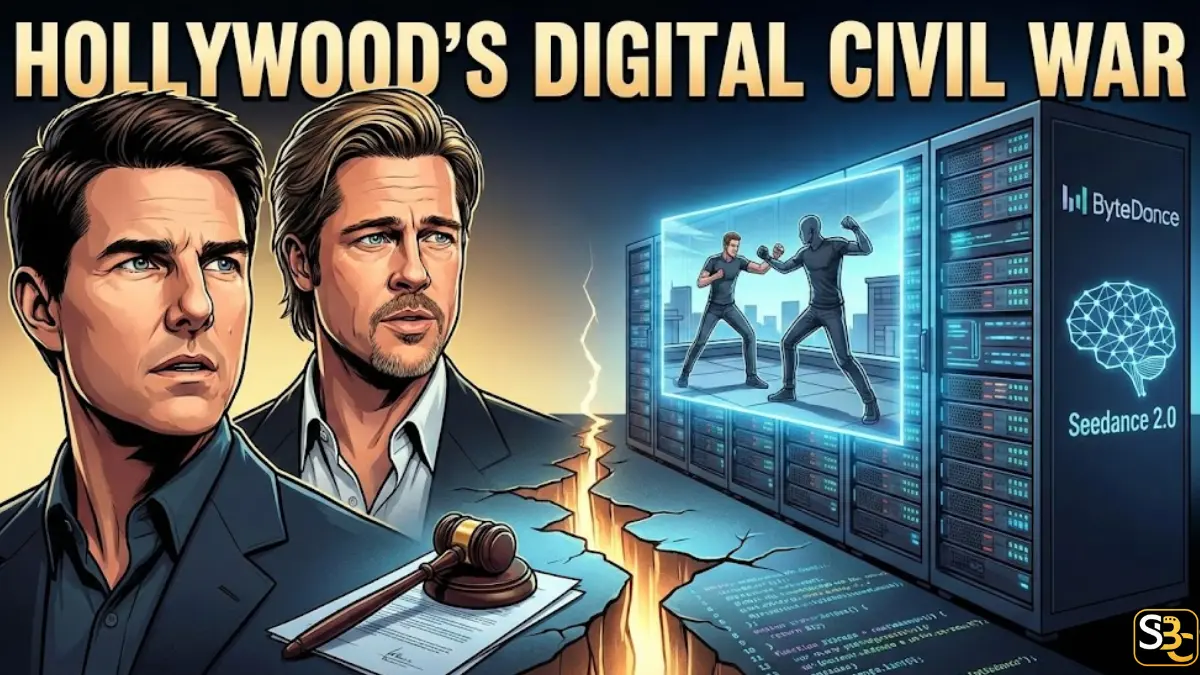
For over a century, Hollywood has functioned on a “Gatekeeper” model. To see Cruise and Pitt on screen together, you needed a $200 million budget.
You needed a major studio like Paramount or Warner Bros. You needed a fleet of lawyers to negotiate the complex contracts of A-list stars.
The Tom Cruise Brad Pitt AI video controversy proved that, in 2026, all you really need is a two-line prompt. A high-speed internet connection has replaced the soundstage.
This specific clip was shared by filmmaker Ruairi Robinson. He revealed it was generated using Seedance 2.0, the latest multimodal AI video tool from ByteDance.
Unlike the glitchy deepfakes of 2023, this video featured perfect fluid dynamics. It showed hyper-realistic facial micro-expressions and a cinematic lighting engine.
It tricked even seasoned industry professionals. The “uncanny valley” has finally been bridged, and the industry is reeling.
The Viral Spark: Seedance 2.0 and the End of “Real” Cinema
To understand why the Tom Cruise Brad Pitt AI video controversy has triggered such a panic, we have to look at the tech. Seedance 2.0 is not a simple “face-swapping” tool.
It’s a “true” multimodal creator. Allowing users to reference specific camera movements and lighting styles.
It even allows for “actor profiles” to generate watermark-free 1080p and 2K content. This isn’t just a toy; it’s a production house in a browser.
Why Seedance 2.0 Is Scaring the Studios
The tool features something called “Multi-Lens Storytelling.” This allows a creator to maintain character consistency across multiple shots.
Theoretically, you could generate an entire feature film featuring a “digital twin” of Tom Cruise. He would never have to step foot on a soundstage.
This is the “existential crisis” that screenwriter Rhett Reese was referring to. The mind behind Deadpool & Wolverine recently tweeted, “It’s likely over for us.”
The Legal Fallout: Likeness Rights and the Disney Offensive
Hollywood isn’t taking this sitting down. The Tom Cruise Brad Pitt AI video controversy has united traditionally divided industry segments.
The Motion Picture Association (MPA) and SAG-AFTRA have issued stinging condemnations. They accused ByteDance of a “virtual smash-and-grab” of intellectual property.
The core of the legal battle revolves around Likeness Rights. Current laws protect an actor’s “right of publicity,” but they are outdated.
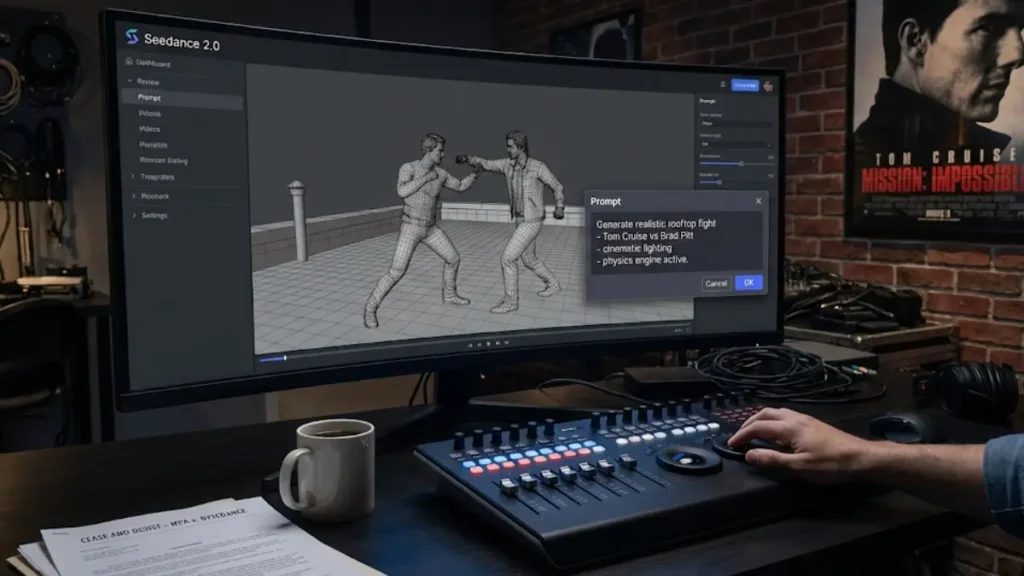
Those laws were written for posters and perfume ads. They were not designed for hyper-realistic digital performances that compete with the actors themselves.
Disney has already sent a cease-and-desist letter to ByteDance. They claim the Seedance 2.0 library was trained on a “pirated library” of Marvel and Star Wars characters.
The “Christopher Nolan” Effect: Democratizing Greatness?
While the studios see a threat, some creators see a revolution. The Tom Cruise Brad Pitt AI video controversy has sparked a debate about democratization.
Rhett Reese noted that these tools might destroy the gatekeeper model. However, they also empower the “next Christopher Nolan.”
This person may live in a small town with zero capital. They now have a massive creative vision and the tools to execute it.
If a 15-second clip can garner 5 million views in 48 hours, it proves a point. “Viral Authority” is shifting away from studio marketing budgets.
Likeness Ownership in the Age of Digital Resurrection
One of the most chilling aspects is the concept of “Digital Immortality.” If a prompt can create a 2026 version of Tom Cruise, what stops a 1990s version?
What stops a creator from resurrecting Marilyn Monroe for a new rom-com? The Tom Cruise Brad Pitt AI video controversy forces us to ask tough questions.
Who owns your face once you’ve achieved global fame? Actors are now pushing for “Likeness Trusts.”
Their digital data must be protected with the same intensity as their financial assets. In the future, the most valuable part of a contract might be encryption keys.
The Technical Specs: How Seedance 2.0 Achieves Realism
The realism of the Tom Cruise vs. Brad Pitt fight isn’t magic—it’s math. Seedance 2.0 uses a “Joint Audio-Visual Generation Architecture.”
The physics modeling is incredible. The way clothing flutters and ice shavings fly during the fight follows real-world gravity.
The “Instruction Following” is the real breakthrough. The model can follow complex storyboards with terrifying precision.
A creator can say, “Use @video1 camera movement with @image1 character style.” This creates a “directorial” level of control never seen before in consumer software.
The “Showbizcast” Perspective on Synthetic Media
We at Showbizcast believe the Tom Cruise Brad Pitt AI video controversy is just the beginning. The line between “Synthetic” and “Authentic” is blurring.
As we move into the second half of 2026, the industry must adapt. Hollywood’s mission is now to find the “Human Edge.”
This is that intangible, soulful spark that AI can imitate but never truly inhabit. The “digital twin” can fight, but can it make us cry?
The Impact on Below-the-Line Workers
It isn’t just the A-list stars who are worried. Stunt coordinators, lighting technicians, and set builders are looking at this tech with dread.
If the Tom Cruise Brad Pitt AI video controversy is any indication, the “physical” part of filmmaking is shrinking.
We are moving toward a “Post-Physical” era of production. This could lead to a massive displacement of skilled labor in the Los Angeles area.
The Future of Viral Marketing
Studios might actually start using this tech for their own marketing. Imagine a world where fans can “prompt” themselves into a movie trailer.
The Tom Cruise Brad Pitt AI video controversy showed that the audience loves this interactivity. It creates a level of engagement that a static trailer cannot match.
But at what cost? If the audience can create their own movies, do they still need the studios?
Ethical Guardrails and the “Truth” Problem
There is also the problem of misinformation. If you can make Tom Cruise fight Brad Pitt, you can make a politician say anything.
The Tom Cruise Brad Pitt AI video controversy is a warning shot for the 2026 election cycle. ByteDance is under pressure to include permanent digital watermarks.
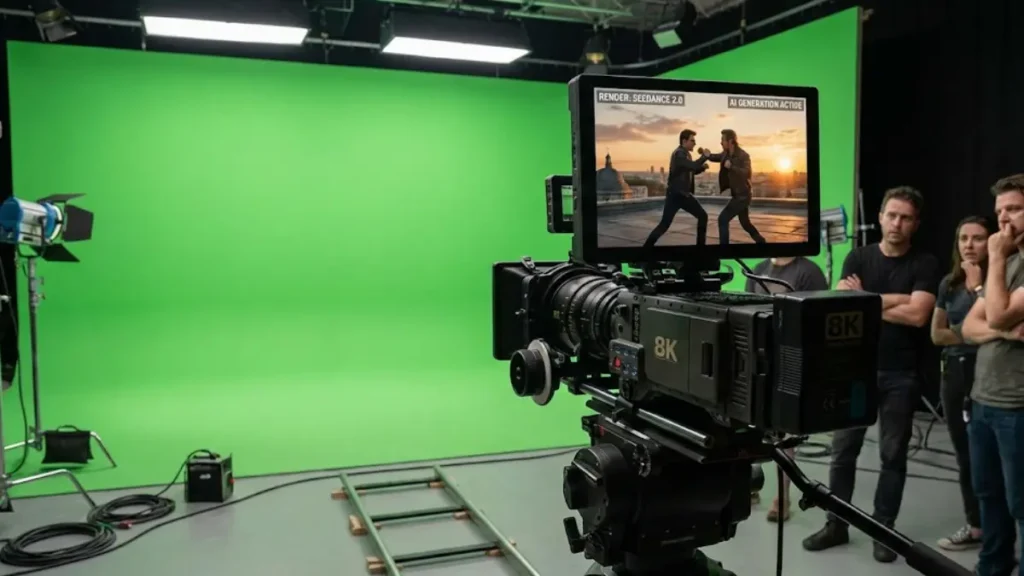
However, “jailbroken” versions of these models are already appearing on the dark web. The “Truth” is becoming a rare commodity in the digital age.
The Role of the Audience in the AI Era
Ultimately, the audience will decide the fate of this technology. Will we pay to see a “real” actor if the “fake” one looks exactly the same?
The Tom Cruise Brad Pitt AI video controversy suggests that the novelty is currently the draw. But as the novelty wears off, we may crave human connection.
At Showbizcast, we will continue to monitor the servers and the soundstages. The war for the soul of cinema has only just begun.
Frequently Asked Questions (FAQs)
A: No. The video was entirely synthetic. It was created using ByteDance’s Seedance 2.0 AI model. Neither actor participated in the filming.
A: Seedance 2.0 is a multimodal AI video generator. It was developed by ByteDance, the parent company of TikTok. It allows for high-definition cinematic creation from simple prompts.
A: This is currently a legal gray area. While “Right of Publicity” laws exist, they are being tested by the Tom Cruise Brad Pitt AI video controversy. New legislation is currently being debated.
A: Industry professionals fear the loss of intellectual property. They also worry about job displacement and the loss of creative control over their own images.
A: In 2026, it is becoming very difficult. However, many models still have trouble with complex hand movements or specific lighting reflections. In this case, the creator admitted it was AI.